Twin Tower Demolition: Key Takeaways
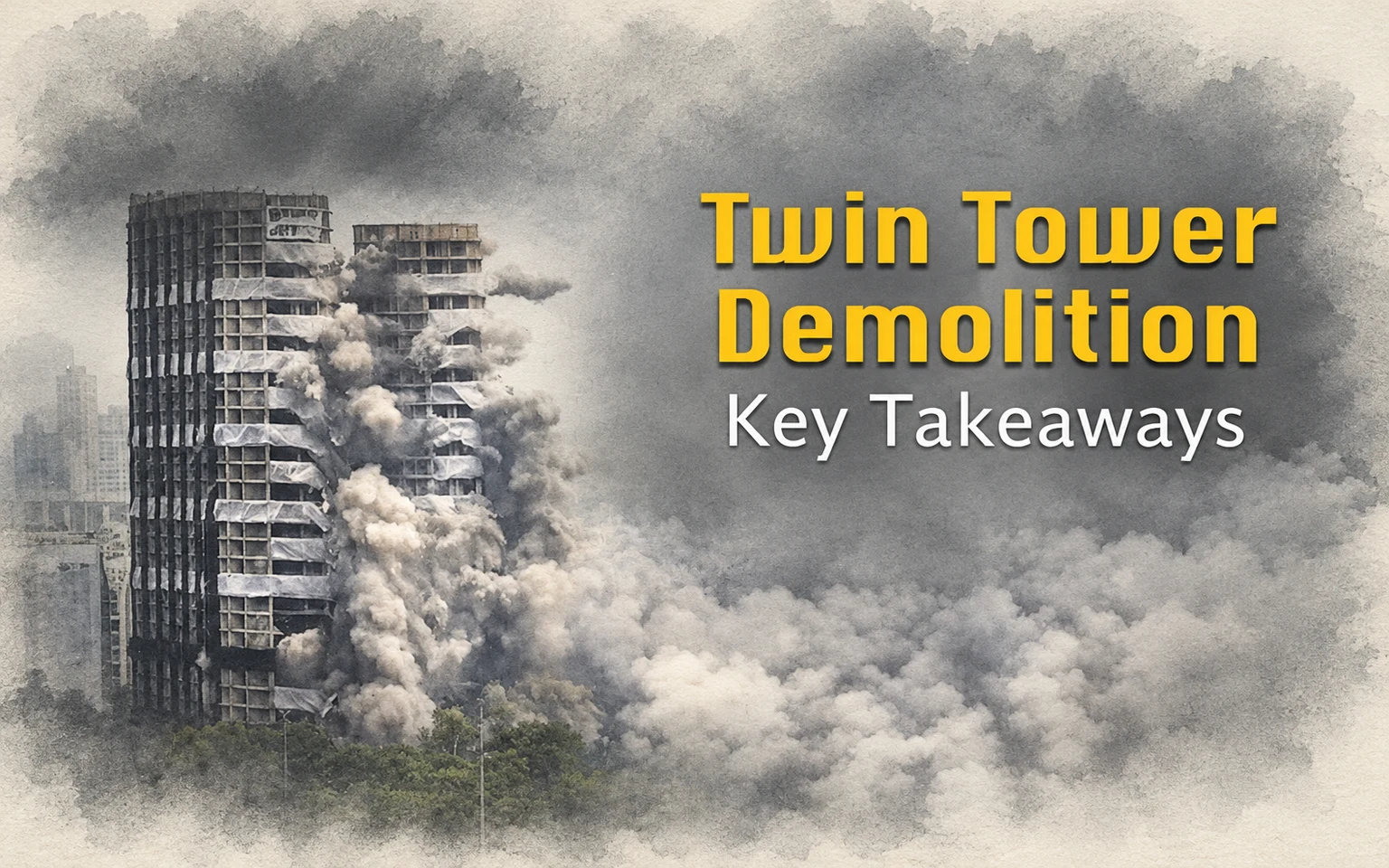
At about 2.30 p.m. on 28 August 2022, Supertech’s twin towers, Apex and Ceyane, in the Emerald Court complex in Noida’s Sector 93A collapsed in a controlled demolition. The images on television brought a long legal struggle into public view. Buildings erected at considerable expense were reduced to rubble within seconds. The spectacle carried a serious message about unlawful construction and the responsibilities of those entrusted with regulating it.
The struggle began with the residents of Emerald Court, who approached the Allahabad High Court in 2012. Their objections included the construction of the towers in an area earlier shown as a garden. On 11 April 2014, the High Court ordered demolition. Supertech appealed, but the Supreme Court upheld that direction in its judgment of 31 August 2021.
The judgment concerned several violations. The minimum-distance requirements arose under the applicable Noida Building Regulations and National Building Code, alongside fire-safety requirements. The protection of purchasers’ interests in common areas and the requirement of their consent involved the Uttar Pradesh apartment laws. The Court also found collusion between Noida officials and the developer. Approval of revised plans did not excuse construction that violated the governing requirements.
The Supreme Court directed Supertech to bear the cost of demolition, with expert supervision and precautions to protect neighbouring buildings. The scale of the operation showed how difficult it can be to remedy a planning failure after construction has advanced. The physical removal of the towers was the visible outcome; the larger task is to prevent such failures before buyers and residents are exposed to their consequences.
The case is a warning to builders who disregard regulations in pursuit of higher profits. A sanctioned plan must be consistent with the law, and commitments made to purchasers cannot be treated casually. Those buying homes often invest the savings of a lifetime. They are entitled to expect that the buildings, common spaces and facilities represented to them will be provided within the applicable legal framework.
It is equally a lesson for development authorities. Their duty is to examine proposals impartially, enforce planning standards and protect the public interest. When officials help a developer evade those standards, the damage extends beyond one project. It undermines confidence in the approval system itself. Effective scrutiny and timely action are essential; violations should not be allowed to accumulate until demolition becomes the remedy.
The persistence of the residents’ association deserves recognition. Its members challenged a powerful developer and pursued the matter through years of litigation. Their action should encourage other associations to understand their rights, preserve relevant records and raise legitimate objections together. At the same time, homebuyers should not have to bear the entire burden of detecting violations and securing compliance. Public authorities must discharge their own responsibilities.
The Real Estate (Regulation and Development) Act, 2016, provides a more specific framework for the rights and obligations of homebuyers and promoters. Its provisions came into force in stages, with the Act fully in force from 1 May 2017. By August 2022, more than five years had passed since that milestone. The framework provides an avenue for grievances, but its existence alone cannot establish that relief is timely or effective in every case.
This is an appropriate time to assess its performance and address deficiencies in the light of experience and judicial decisions. Abandoned projects, delayed possession, departures from promised quality and facilities, and conflicting claims over property continue to demand attention. Projects that require registration must not be allowed to evade it. Buyers need remedies that can be implemented, as well as decisions recognising their rights.
The twin-tower episode should strengthen the resolve to uphold the rule of law in urban development. Its lasting lesson lies in responsible approval, honest construction and the willingness of residents to challenge wrongdoing. Let us hope that the institutions responsible for protecting homebuyers act early and effectively, so that another such spectacle need not become the means of enforcing the law.
Leave a thought
No account needed. Your name and comment appear publicly after approval.