Biotechnology Landscape in Odisha: Problems and Prospects
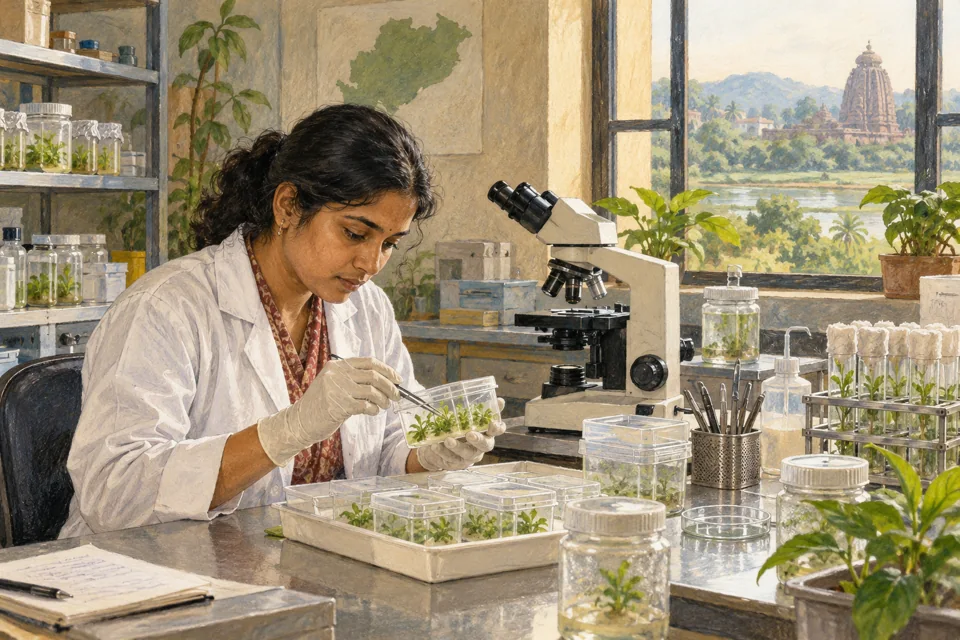
Biotechnology in Odisha has a promising foundation in research, education and manufacturing. The challenge is to build these strengths into a broader industry capable of contributing to healthcare, agriculture, environmental protection and employment. The State Government’s policy and financial commitments offer an opportunity to do so, provided they are followed by sustained implementation.
Challenges and opportunities
Biotechnology requires specialised laboratories, incubators, equipment and access to testing facilities. The Biotechnology Park at Andharua, on the outskirts of Bhubaneswar, is an important part of this effort. In January 2025, The New Indian Express reported that Sapigen Biologix’s vaccine manufacturing facility there had been established with an investment of Rs 1,500 crore. The central drug regulator’s 2024 records identify Sapigen as a subsidiary of Bharat Biotech International and list vaccine manufacturing permissions for its Andharua premises. Vaccine manufacture is a substantial biotechnology activity and can provide a foundation for further development.
The larger task is to extend such opportunities to a wider range of enterprises. Smaller firms need affordable access to infrastructure and scientific expertise. Biotechnology involves long development periods and considerable risk; attracting private investment therefore requires patient finance, dependable facilities and effective support through the stages between research and production.
Odisha’s academic institutions provide a valuable pool of talent. Industry-ready skills must be developed alongside academic knowledge, with greater attention to practical training, quality control and the demands of production. Opportunities for graduates to work with enterprises would also help the State retain skilled personnel.
Stronger links between industry and academia are essential. Research can serve society more effectively when institutions and enterprises work together on useful products and processes. Startups need mentoring, incubation and assistance with intellectual property and regulatory requirements. These should be continuing services, accessible beyond the initial announcement of a project. The adequacy of policy support should be judged by how effectively it meets these needs.
Policy support and the way forward
The Odisha Biotechnology Policy 2024 provides a framework for investment, research and entrepreneurship. Its incentives include capital investment support, assistance for technology acquisition and upgradation, and intellectual property registration, subject to the policy’s eligibility conditions. Biotechnology is also a thrust sector under the Industrial Policy Resolution 2022. Together, these measures give the sector a recognised place in the State’s industrial development strategy.
Contemporary reporting of the Cabinet decision of 6 June 2025 records approval of the Development of Biotechnology scheme at an estimated cost of Rs 1,113.50 crore for 2025–26 to 2029–30. Its 17 sub-schemes are intended to support higher education, research, infrastructure and industry-oriented development. The policy’s five Is—Innovation, Incubation, Investment, Income and Impact—provide a useful statement of the ambition. The task is to carry ideas through to products, commercial applications and wider social benefits.
Existing institutions can play a central role. The Institute of Life Sciences, Bhubaneswar, within the Department of Biotechnology’s BRIC research network, contributes to research and scientific training. Utkal University’s Department of Biotechnology and the biotechnology department of Odisha University of Technology and Research also offer an academic base on which to build. Their expertise should be connected more closely with enterprise needs while preserving the value of fundamental research.
Implementation should bring together research institutions, universities, industry and government. Shared facilities, practical training and support for commercialisation deserve sustained attention. Progress can be assessed through functioning infrastructure, research collaborations, products reaching the market, skilled employment and the survival and growth of supported enterprises. Financial allocations and investment announcements are beginnings; their value will lie in the opportunities they create.
Odisha has reason to look ahead with confidence. Its research institutions, vaccine manufacturing investment and dedicated policy support offer a stronger basis for growth. With patient investment, capable administration and close industry–academia cooperation, biotechnology can become a meaningful contributor to the State’s economy and public welfare.